 Skip to content

Copper Peptide & PDRN Micro-infusion vs Injectables for Hooded Eyes: The at-home solution that doesn't keep you in a cycle of in office treatments

You've already done the homework.
Read the reviews on skincare subreddits. Watched a med spa ad load before an Instagram reel. Googled "brow injections before and after" for the third time this month. You're somewhere between "my lid space is disappearing" and "I'm not sure I want to get injected every three months for the rest of my life."
By the end you'll know exactly which approach fits best for lifting hooded eyes without the risks and high costs.
This decision is bigger than women think
Eyeshadow that used to sit where you placed it vanishes when your eyes are open. Mascara stamps the skin above your lashes by midday.
The root cause of this is collagen production in the skin around the eyes that drops significantly after 35. The problem is the upper eyelid area, already the thinnest skin on your body, loses firmness and volume faster than almost any other area.
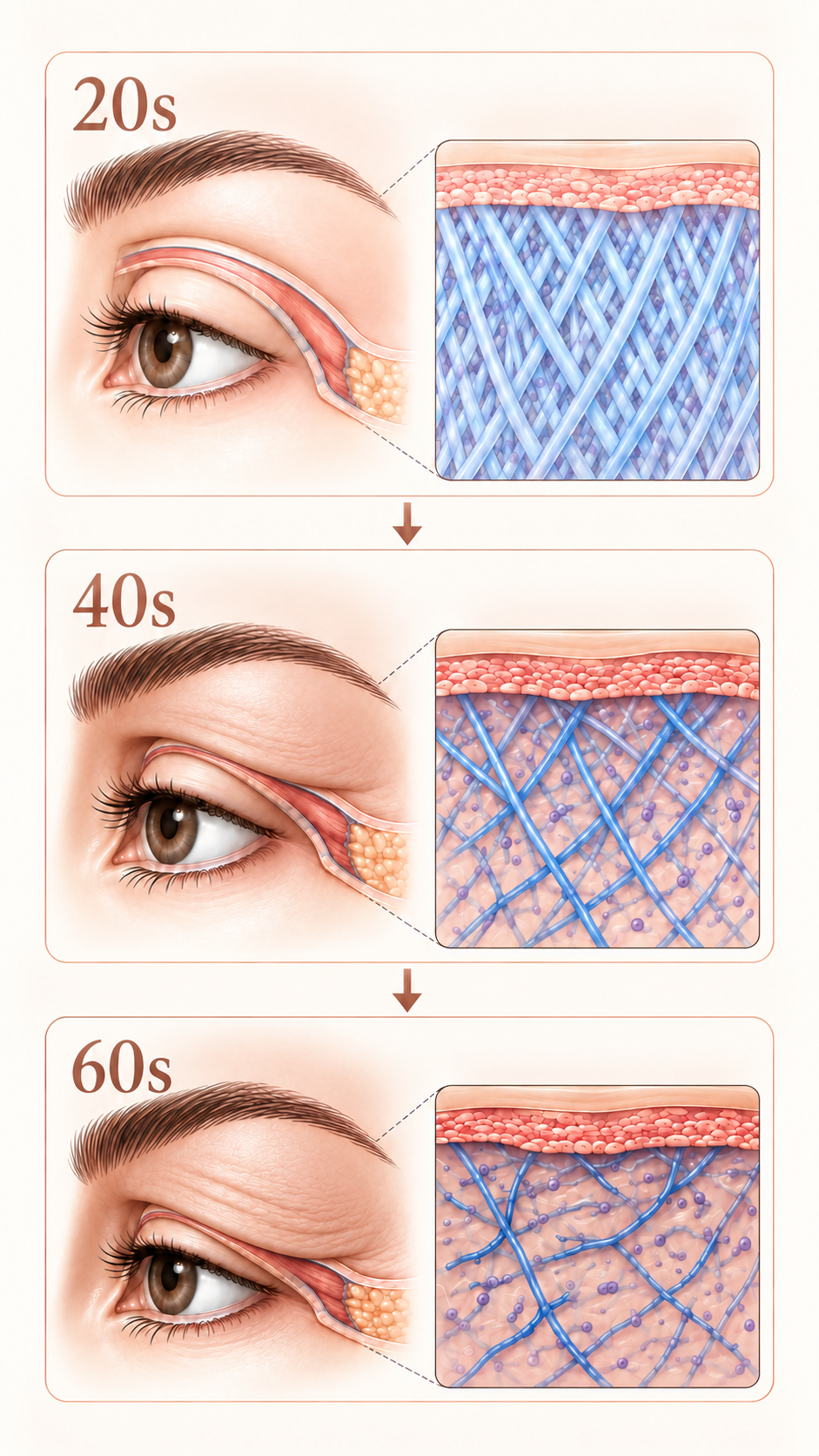
The market has answered with two very different approaches. Temporary muscle paralysis, administered by a clinician at regular intervals. And at-home micro-infusion, which delivers tissue-rebuilding & collagen boosting actives directly into the area where the breakdown is occurring. Each works through completely different biology. Each commits you to a completely different relationship with your own skin. Choosing wrong costs years.
The system
Your upper eyelid holds its shape because of two structural layers. Collagen keeps the skin firm. The tissue underneath provides thickness and hold.
Collagen signals the cells to maintain structure. The tissue provides the volume that keeps the lid lifted. Together, they hold the skin above the eye in place.
But when the eyelid starts sagging and lid space becomes less visible, this is how injectables attempt to lift the area.
An injection paralyzes the muscles around the brow. The brow lifts slightly. The fold looks less heavy. Then the brain detects the paralysis, and the muscles gradually recover over 8-12 weeks, and the brow settles back to where it was. The collagen is still depleted. The tissue is still thin.
The problem keeps worsening underneath injectables covering it up.

The clinical reality of what that means for hooded eyes:

How PDRN & Copper Peptide Micro-infusion works
PDRN & copper peptide micro-infusion runs the rebuild directly, in two places at once.
Rebuild lost collagen. This copper peptide has been studied for over four decades in dermatology and wound healing research. It signals skin cells to manufacture collagen in the upper eye area for lifting.
A human trial comparing copper peptide against vitamin C and retinoic acid found collagen increases in 70% of subjects of the latter. Copper peptide outperformed both.
Regenerate thinned tissue. PDRN, a repair molecule derived from salmon DNA, used in clinical and cosmetic applications for over 25 years. PDRN activates the body's tissue regeneration pathway, promoting new tissue formation for tightening and brightening the upper eye area.
Where copper peptide addresses the collagen that lost its structure, PDRN addresses the tissue that lost its thickness.
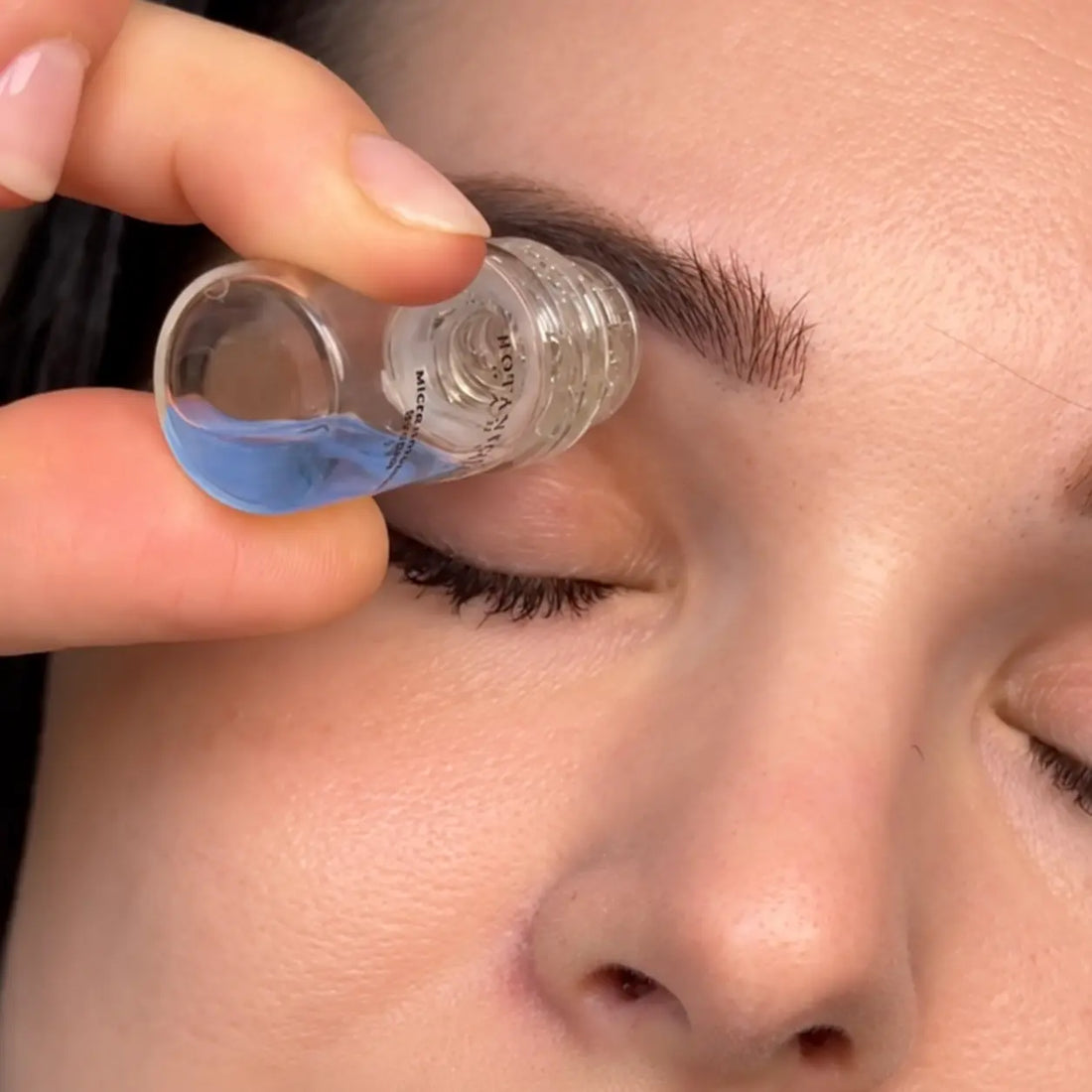
Delivered at the depth that matters. Microinfusion uses a small handheld stamper pressed along the brow bone and orbital rim. It creates channels 0.25mm deep. Shallow enough that most women feel nothing. Deep enough to get past the barrier that stops every cream and serum from reaching where the breakdown is occurring. Five minutes. Twice a week.
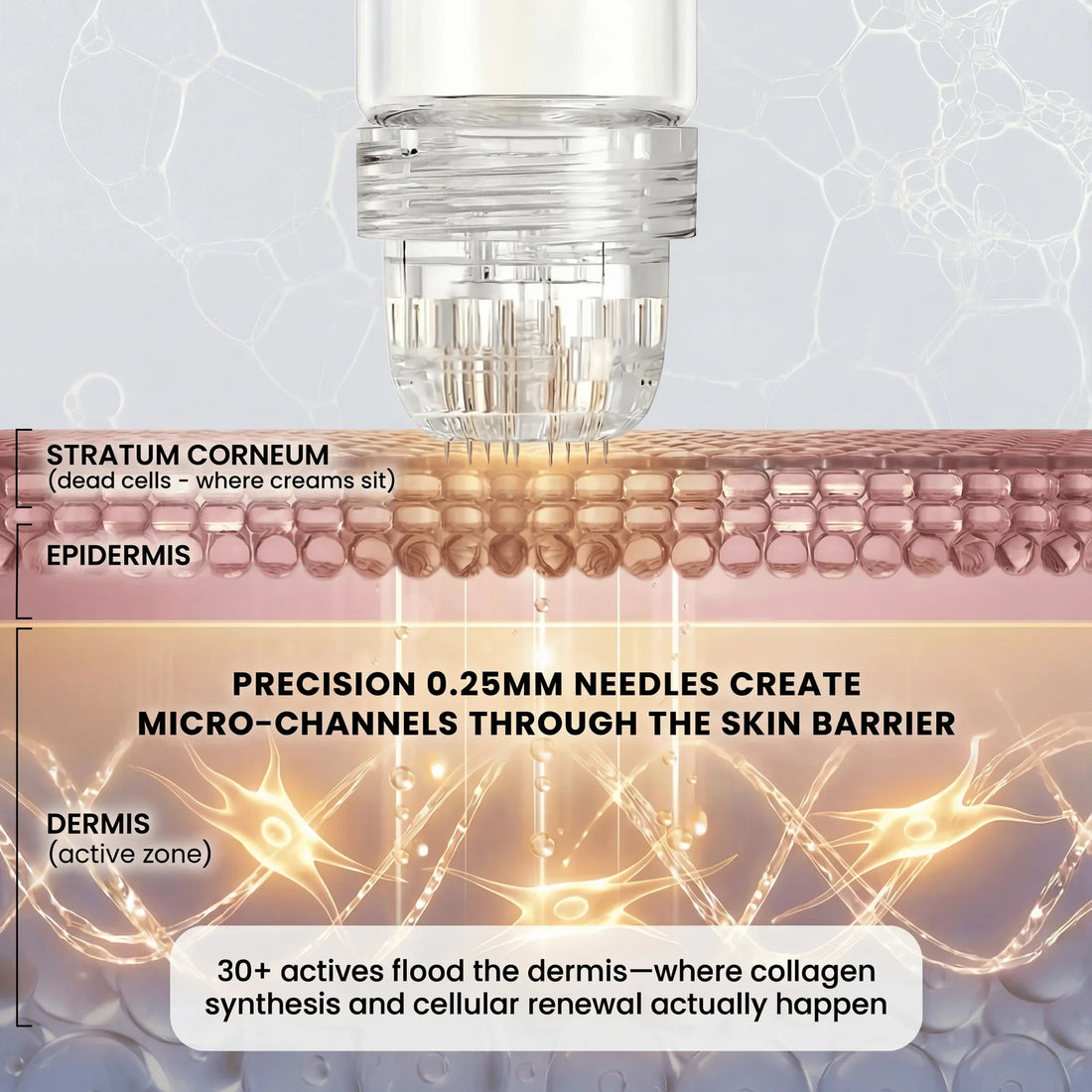
Clinically proven pdrn & copper peptide concentrations · 365-day money-back guarantee
Try the system risk-free →The five differences that matter most for lifting hooded eyes
Injectables are effective at what they do. They paralyze muscles. For crow's feet and forehead lines, that's exactly the right mechanism, because those wrinkles are caused by repeated muscle movement. For hooded eyes, the fold is caused by collagen loss and tissue thinning. Muscle paralysis doesn't interact with either one.
Injectables last 8 to 12 weeks per round. Then the paralysis fades, the brow settles, and you book again. There is no cumulative benefit. Week one of your fifth session is identical to week one of your first.
Injectables can migrate from the injection site into the levator muscle, causing the lid to drop heavier than before treatment. Bruising at the injection site is common. Headaches are a reported side effect. Some women develop antibody resistance over time, meaning results shorten with each round. None of that means injectables are bad. It means injectables are a medical intervention, and medicine carries risk.
Brow injections typically run $300 to $600 per session, three to four times a year. That's $1,200 to $2,400 annually, plus the time cost of appointments, travel, and the occasional bruise you weren't expecting the day before an important event. It requires a trusted provider to apply too.
Injectables are the right answer when overactive muscles in other areas are the cause, when you've found a provider you trust, and when the maintenance cycle fits your schedule and budget.

The delivery comparison
Injectables deliver a neurotoxin via clinical injection into specific facial muscles. It's a paralytic, not a skincare active. So the risks that come with the delivery conversation are fundamentally different.
For PDRN & Copper Peptide Micro-infusion, controlled concentrations are delivered right below the skin barrier. Nothing else is at risk. Injectables use diluted toxin on the other hand to freeze the muscle area which weakens the area over time. Causing more drooping.

Most eye products list an active ingredient and skip the delivery question. The micro-infusion system answers it at 0.25mm, every session, with clinically proven concentrations in the exact area where the breakdown is happening.
What women who used injectables say
Injectables
Women who get brow injections for hooded eyes generally do see a slight lift while it holds. The most common frustrations aren't about whether injectables perform during those weeks. They're about the cycle. And if it's worth the risks repeating it. The fade startis again around week eight. Then comes rebooking and repaying. The math of spending $1,500+ a year for life to rent a result that resets every single quarter.
Micro-infusion
Trust and transparency
Copper peptide has been studied for over four decades. Research published across dermatology, wound healing, and regenerative medicine confirms its ability to stimulate collagen synthesis and support tissue remodeling. PDRN has been used commercially in medical and cosmetic applications for over 25 years, with systematic reviews confirming its role in tissue regeneration.
Both are delivered at clinically proven concentrations, at a controlled 0.25mm depth, in the supraorbital area only. Every ingredient is disclosed and specified for peace of mind. With a full 365 day money back guarantee to make it risk-free for you.
- 365-day
money-back guarantee - Clinically proven
concentrations - Every ingredient
disclosed
You already know which path you're on
You've looked at the data. You've seen the costs and what each path requires.
Notice which one felt like relief and which one felt like a trade-off.
The verdict
Injectables have clinical presence. It's the procedure so-called 'skin experts' often suggest first. The appointments are quick, the results show up fast, and every med spa within driving distance has it on the menu.
What it doesn't have is a solution that interacts with the root cause of upper eyelid hooding. It paralyzes muscles around sagging caused by structural breakdown, holds that paralysis for 8 to 12 weeks, then lets go. No cumulative benefit. No rebuild. No lasting lifting from repairing damage.
If you've been considering injectables for your hooded eyes and something about the cycle felt off before you even started, that instinct is correct.
The math on paralyzing muscles every quarter to manage a collagen and tissue problem doesn't usually favor the customer. It favors the industry.

365-day money back guarantee
Try the system risk-free →Frequently asked questions
Is micro-infusion an alternative to injectables?
Micro-infusion is an at-home lifting system for hooded eyes that rebuilds collagen and tissue in the upper eye area. Injectables are clinical injections that paralyze muscles. They work through different biology. Micro-infusion is most useful for women with hooded eyes who want to address the structural cause rather than mask it.
Can I use micro-infusion while still getting injectables?
After using this microinfusion system on the upper eye area for a few weeks, women don't tend to ever look back at injectables for hooding specifically. However, many women continue injectables for forehead lines while using micro-infusion for hooded eyes. The two are not in conflict if used in other areas.
How long until micro-infusion works?
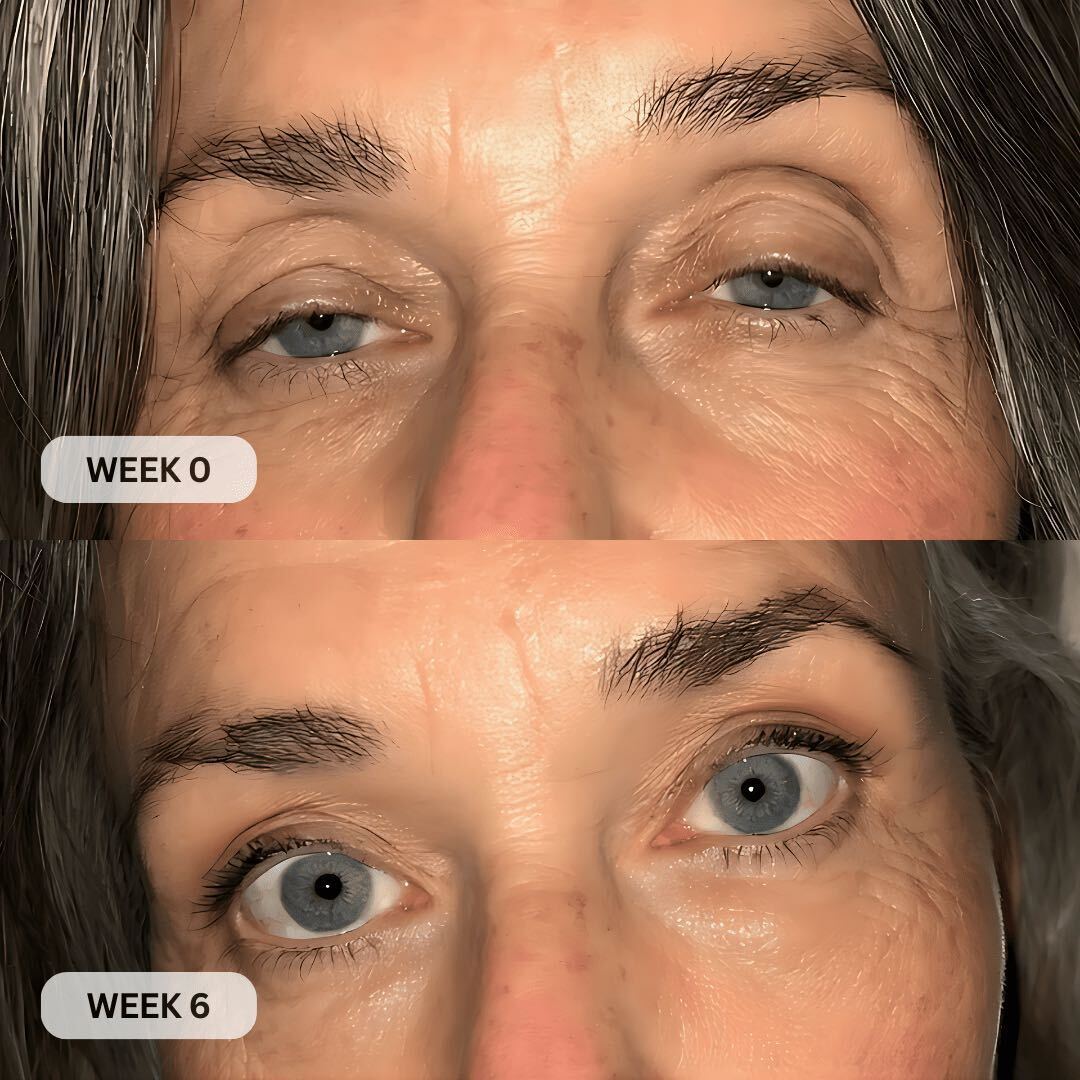
Two weeks for first signals (firmer lid area, makeup sitting better). Six weeks for visible changes (lid space opening up, reduced heaviness). Continued improvement through twelve weeks and beyond in most cases. The 365-day money-back guarantee covers you trying it risk-free. You get results or you don't pay.
Is micro-infusion safe for the eye area?
It's painless and not used on the skin of the actual eye itself. This is designed for the supraorbital area only, along the brow bone and orbital rim. Plus the 0.25mm depth is shallow enough that channels close within minutes. Women say they feel nothing but a gentle stamp during use.
Sources
- 1. Farage MA, et al. Structural characteristics of the aging skin. Cutan Ocul Toxicol. 2007;26(4):343-357.
- 2. Maquart F, et al. Stimulation of collagen synthesis in fibroblast cultures by the tripeptide-copper complex. FEBS Lett. 1988;238:343-346.
- 3. Abdulghani AA, et al. Copper-binding peptide vs tretinoin. Disease Management and Clinical Outcomes. 1998;1:136-141.
- 4. Squadrito F, et al. PDRN and impaired skin wound healing. Pharmaceuticals. 2021.
- 5. Guizzardi S, et al. PDRN: Tissue Regeneration and Healing. 2024.
- 6. Carruthers J, Carruthers A. Complications of cosmetic brow-area injectables (review). Facial Plast Surg Clin North Am. 2007;15(1):51-54.
- 7. ASPS. Average brow injectable cost per treatment area: $300-$600. Recommended frequency: every 3-4 months.